Showing posts with label demonstrators. Show all posts

Sunday, July 24, 2011

Last Minute DEMONSTRATIONS

- In case you missed the final published schedule (July 12) there were some final additions to fill the last gaps - in what was already a pretty packed demonstration schedule:

DAVID ROBERTSON - Saturday, 9 to 12 AM - 'Beyond the Basics'

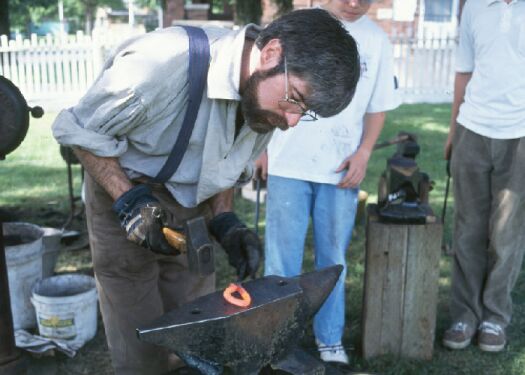
David operates Hammer & Tongs, and is widely know via his membership list at artistblacksmith.com. This forge work experience goes back to the early 1980's. He is one of the best known teachers of introductory and intermediate blacksmithing in Ontario. David's demonstration session will be ideal for those who are looking to expand 'beyond the basics', illustrating more complex shaping techniques for those who have gotten serious about their blacksmithing hobby and want to progress to the next level.


MICHAEL MCCARTHY - Thursday, 8 to 9:30 PM - 'A Sculpted Head'

Mike is one of our featured demonstrators. He has offered to present an additional short session at CanIRON 8. He will be demonstrating how three dimensional punching can be used to create a specific decorative terminal, a sculpted face / head. He says the form 'looks like an old man's face to start, then you fold it over and it looks like a human head from one angle, and almost like a horses head from another.' Of certain to be of interest to those who like to work with punch work techniques.

DAVE KRITZ - Thursday, 8 to 9:30 PM - 'Copper Leaves'

Dave is a local Ontario smith. He often demonstrates to the general public, but this will be his first major to fellow blacksmiths. Dave has developed some cold working techniques using copper tubing and sheet. He will be illustrating these methods - which can make nice additions to your smaller forged projects.

ROBERT WAGNER - Sunday, 9 - 12 AM - 'the Historic Forge'

Robert will be undertaking a display and demonstration of his War of 1812 styled portable charcoal forge. This is part of our free public outreach programming. Come take a look and where blacksmithing in Ontario started - and how far we have come.


Only FIVE more days!

Monday, June 20, 2011

Some things are free, but much more with Membership!

On 19/06/11 6:28 PM, John wrote:
Is it true that the iron smelt is on Thurs. only? That is my primary interest at the conference ...


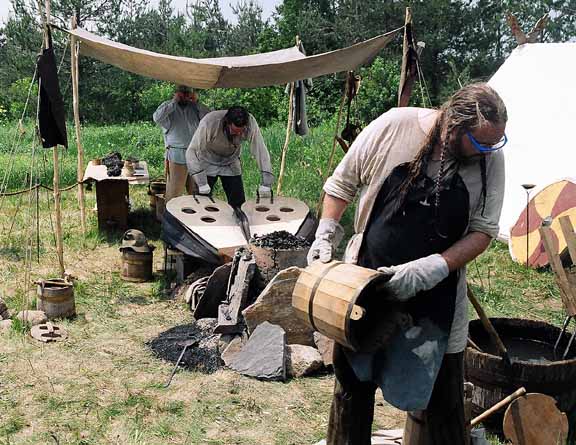
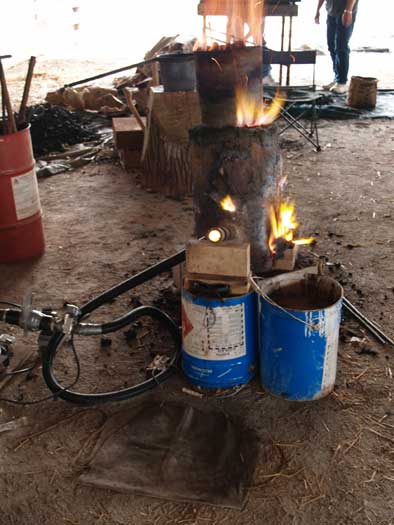
The iron smelt by members of the Dark Ages Re-Creation Company will take place over the full day of Thursday 28, the opening day of CanIRON 8. The team will start the furnace build roughly 9 am, expects to be ready for the start of main sequence by noon, pulling the bloom roughly 4:30 - 5 pm.

This is a free, public outreach part of the conference. I'm expecting that I personally will be stuck running around organizing, but feature demonstrators Mike McCarthy and Jesus Hernandez are members of the "Early Iron Underground" and will be able (Mike especially) to lend a hand.

Of course you might expect that I should be plugging the full four day conference!

Jesus Hernandez, who works in the Japanese bladesmithing traditions, will be taking part of the DARC iron bloom and later demonstrating forging it down to a blade blank.


If you are interested in ancient historical methods, I think you will be interested in the (amazing) work of Jake Powning, who will be demonstrating Viking Age style pattern welding (twisted composite core), plus lecturing on his blend of Celtic and Norse designs.


There is a packed schedule of feature demonstrations, hands on workshops, lectures and panel sessions for paid registrations to CanIRON 8. One of the missions of the hosting organization, the Ontario Artist Blacksmith Association, is to inform and educate the general public about the 'art and mystery' of the blacksmith. For that reason we have included a full program of public outreach events.

Other aspects of CanIRON 8 which are being presented as FREE public access:

- Friday & Saturday (roughly 9-12 a + 1:30-4 p): Come see members of OABA, under David McCort, work on completing the Fergus Park Bench project.
- the Gallery is open daily from 1:30 - 4:30 p, including 'meet the artist' sessions
- our Auction takes place Saturday starting at 6:30 p, bid on original hand forged art pieces (plus smithing related items like tools and hands on courses)
- 'Hammer In' style demonstrations, Sunday 9 - 12 a, where members of OABA will present their skills using a range of forge equipments and working styles.
- Forging Competition, Sunday 1:30 - 4:30 p, always a lot of action and highjinks as teams of smiths (stuggle?) to make an object with limited materials and time.


Monday, June 28, 2010

Paul Allen

Dorset, England

www.artinmetal.co.uk


Growing up in rural Dorset, Paul Allen considered
training to become a silversmith in Birmingham. But the lure
of the countryside led him to take up a forgework apprenticeship
in blacksmithing at Cerne Abbas in Dorset – the start
of a fascinating career in metal.


Eager to share his knowledge and enthusiasm, Paul left Cerne
Abbas at the age of 26. He took on the challenge of using
his skills and talent to train young blacksmiths all over
England for the Council of Small Industries in Rural Areas.
His flair for design led to major projects being awarded to
the student apprentices. These included a seat for the Ironwork
Gallery in the V & A Museum and an ornate archway for
the Zachary Gardens in London, commissioned by the Goldsmiths
Company and incorporating the London Assay mark.


National UK Champion Blacksmith in 1994, Paul is a certificated
Licentiate teacher and Liveryman of the Worshipful Company
of Blacksmiths, as well as a Licentiate of the City &
Guilds Institute. He is still actively involved in teaching
as a part-time tutor at the National School of Blacksmithing
in Hereford and is well known all over the country.


At home in his studio at Motcombe Forge Paul specialises in
producing original designs for interiors. Working in iron
and other metals he uses only pure forgework techniques. The
materials are chosen to enable delicate designs to be worked
by hand; creating natural flow and balance within the practical
function. From sweeping sinuous lines and personification
of plant forms through to functional straight lines, his designs
are often inspired and influenced by natural shape and forms.
Commissions range from candlesticks to coffee tables and table
lamps, creating quality style essentials which never go out
of fashion.


(taken from Paul's Web site)


Table Lamp

" Circular base with central column that branches out to support
the decorative shade, which incorporates honeysuckle flowers and stained
glass. Size 55cm high x 37cm wide. Made from mild steel with a lacquered
finish.

...The shade is made using repoussé techniques to form the flower
features and hand chasing to add decoration. The central column and decorative
infills that hold the glass are hand forged. "


Bench - V & A Museum, Ironwork Gallery

"History was made at the Victoria and Albert Museum in South Kensington
when visitors were invited to sit on one of the exhibits.

... The bench seat has a coat of arms combining the logos of the V &
A and The Ironmongers Company who provided the funding. Situated in the
Ironwork Gallery the bench commemorates the opening of the gallery’s
eastern wing in 1998. "


"Vortex in Fire" Candelabrum

A pair of highly polished candelabrum with three outer and one central
candleholder with removable sconces. Hand made and formed in stainless
steel using lead block, stake work and repoussé techniques. Size
460mm high x 380mm wide.


Paul's web site features a gallery
of past work and details on the historic Motcombe Forge ��

Friday, May 14, 2010

Demonstrator Profile - Sandra Dunn

Sandra Dunn
Kitchener, Ontario
www.twosmiths.ca


" Blacksmith Sandra Dunn studied Fine Arts at the University of Waterloo and began blacksmithing in 1996. Incorporating traditional blacksmithing techniques such as forge welding, riveting and mortise and tenon joinery, her work reflects a deep interest in the gestures recorded by material that has been worked by hand."

Full time blacksmith since the mid 1990's, Sandra operates Two Smiths, a business that designs and builds architectural features in a variety of metals and styles. From restoration work to contemporary sculpture,projects often involve collaboration with architects, artists and other manufactures and include a stainless steel bicycle powered wind instrument for Open Ears Festival, bronze clad Art Deco entrance doors for the Registry Theatre, a curved copper wall in a Manhatten loft and a Baroque iron railing in Bornholme, ON.
Sandra has been a featured demonstrator at earlier CanIRON's : Ness Creek, Saskatchewan (2009) and Hamilton, Ontario (2005)


Interior Staircase railing


Detail of Forged Railing


Gate Latch

Sandra's web site includes a small portfolio and information about courses in metalsmithing.

Thursday, April 1, 2010

Kelly Smyth - Demonstrator Profile

Kelly Smyth
ChaddsFord, Pennsylvania
web profile


With nearly all experience in blacksmith shops using traditional
tools and techniques (often without electricity), Kelly is convinced it is the easiest way to make accurate copies of hardware for either newly constructed historic
ships or buildings.
Smyth spent five years in a blacksmith’s costume at Colonial Williamsburg before connecting with shipbuilder Allen C. Rawl and his Kalmer Nyckel. She’s also participated in the Smithsonian Folklife Festival and consulted with the Smithsonian to review hardware recovered from Cleopatra’s Barge. Built in Salem, Mass., in 1816, it was owned by the king of Hawaii when it sank in 1824.
Past projects include all the hand forged hardware for the new version of Discovery (1607) at Jamestown Settlement in Virginia and the John Smith 400 Shallop, an eighteenth century topsail schooner, originally constructed in Chestertown on Maryland’s Eastern Shore. Dry land work has included hardware for the new Print House (1672) at Historic St. Mary’s City on Maryland’s western shore, both colonial capitols in the seventeenth century as well as private commissions.


Forge welding heavy ship's fittings (Image by Chris Queeney)


18th Century Door Latch
Private Commission, Esssex County VA


Chain Plates for the Discovery, Jamestown Settlement

Kelly does not currently support a web site

Tuesday, February 23, 2010

Brian Russell - Demonstrator Profile

Brian Russell
Little Newsham, County Durham, England
www.littlenewshamforge.com


" Towards the end of my four years at art college, the thought entered my head that it might be fun to be a blacksmith. I really wanted to serve an apprenticeship with a blacksmith, but in early 1970`s England they were very thin on the ground. There was no BABA or ABANA, no internet, no way of contacting other like minded people. I was offered a forge in a lovely old farming village in the north east of England and opened up for business in 1976, armed with two books by Fritz Kuhn and copies of the Cosira books : "A Blacksmith Craft," and "Wrought Ironwork". Shortly afterwards, I had a couple of short visits from a Cosira instructor, Ron Brown, who arrived with a bag full of ram`s heads, snails and leaves of all descriptions. This opened my eyes to possibilities that I had previously not considered; decorative features did not have to be scrolls! The founding of The British artist Blacksmiths Association in 1978 had a major impact on the work that I was designing and making. I was able to meet and see the work of craftsmen from all over the UK who had been established for years, producing amazing shapes of all descriptions in forged metal. This was a big eye opener for me, I had to go out and find a power hammer, to enable me to work bigger sections, and quicker!
" I do prefer architectural scale work,with as many forged elements in it as possible, so it will be fun to make. It`s a good feeling to have a pile of forgings on the floor at the end of the day. I don`t buy components from catalogues, for me it would be wrong to include pieces designed and made by others in my work, no matter how good the quality or how cheap. Having said that,for some jobs we do have blanks either laser cut or gas profiled to be forged into finished shapes by us. I continuously try to come up with new ideas, it`s not always easy,as there is so many clever blacksmiths out there now, and I have designed so much myself over the years, that it is difficult to come up with new forms.
" I try to make the work that we do as varied as possible, although there is no getting away from natural forms, is there? We love rivetted gates, with mortice and tenon joints,whether large or small. Sometimes these have traditional forms but more often with a design that hopefully will stand out as being different. Forge welding is a process I really enjoy, and use as much as possible. I think that most people regard me as a craftsman that will only work traditionally, and while I do prefer to work in this way, I do take on sculptural projects that by the size and the nature of the design, make it necessary to use modern methods as well. "


Barley Hand Rails
These rather more contemporary features are to be found on a cottage that was formerly a malt house. They feature heads of Barley and germinating grains.

"We are lucky in having a good client , a property developer who keeps coming back for more work,and gives me a pretty free hand with the design.This is an old cottage he owns which used to be a malthouse, so I tried to incorporate this aspect of it`s history. All the elements are forged but the assembly is a fabrication job.If I remember correctly,the grains are swaged from 70mm round, the tools made from a pattern turned on our old lathe.We make a lot of these tools, you can reproduce almost any shape of a circular section."


Table Candle Holders
A pair of candleholders showing how plant forms can be used with good effect in forged Metalwork.
"...a rare commission for us these days. Although we make quite a lot of candleholders for churches, these were for a private house. It makes a welcome change to do small scale work now and again, I sometimes think we don`t do enough hand forging..."


Brancepeth Screen
A forged steel screen, backed by toughened glass, in the ancient church of St. Brandon near Durham.

" This piece is in a church dating from the 11th century. It is a screen glazed with toughened glass to provide a quiet room in the church.It was far too big to fit through the church door,so a window had to be taken out ,and the 800 kg screen passed through on edge ( with 75 mm clearance).It was a delicate operation. "


Also on Brian's web site: An extensive portfolio of his past work, primarily architectural pieces. On the front page is a slide show feature that shows concept drawings which fade into an image of the competed works. On the 'Image Gallery' are many of his (high quality!) design drawings.

Friday, February 5, 2010

the Dark Ages Re-creation Company - Demonstrator Profile

the Dark Ages Re-creation Company
Central Ontario


" The Dark Ages Re-creation Company is composed of people interested in using living history to research aspects of life in Northern Europe during the Viking Age. This is accomplished through workshops and experimental archaeology where the focus is on developing traditional skills as we create accurate replicas of period artefacts and processes. ... The Company further strives to provide a resource of skilled and experienced historic interpreters and physical demonstrators to museums, schools, and educational programs."


"DARC's Experimental Iron smelting is based on archaeological evidence, and are targeted to recreate the techniques the Viking Era Norse used to smelt iron. ... Our goal is to get a method that first reliably produces iron, and second uses equipment that would have been available historically, and third that matches the archaeological record that we have with regards to blooms produced, smelter and surrounding area layout, and materials."
The link between iron smelting and the Viking Age lies in the fact that the first documented iron production in North America was by the Norse at L'Anse aux Meadows Newfoundland (Vinland) circa 1000 AD. Team members from DARC have demonstrated both historic and practical modern methods for smelting iron before the blacksmithing community : at CanIRON 5 (2005, Annapolis Royal Nova Scotia) and at Quad State (2008, Troy Ohio)
(above June 2005 - An early experiment with all Viking Age equipments
image by Neil Peterson )


May 2005 - Taping slag from a firebrick furnace.
image by Neil Peterson


At Quad State - View of a simple clay smelting furnace in operation.
image by Darrell Markewitz


November 2009 - starting to hammer work the hot bloom
image by Darrell Markewitz


DARC maintains considerable information on its ongoing research work on the web, including its experimental iron smelting.
Further information on DARK's work is also to be found on the web site of Darrell Markewitz, which includes YouTube clips as well.

Saturday, January 23, 2010

Michael McCarthy - Demonstrator Profile

Michael McCarthy


" My mission, in simplest terms, is to "Preserve, study, advance and exchange the techniques of the pre-industrial metalworker, In order to help build independence and productivity in those who may benefit from it."

" My vision statement, in part an effort to clarify the above: "Foster and develop an environment of study and research. Present the craft to those with interest. Provide a clearinghouse of information as regards the craft. Help to provide a voice for traditional crafters. Seek out opportunities to teach others."

" I became intrigued with the work of Paul Spaulding and went looking for an apprenticeship with him. I thought I would stay in his shop for a year or so and "bone up" on my forging skills. Seems laughable to me now. Five years later (2005), I find myself running the shop (at the Farmer's Museum, Cooperstown NY).

" My dream had long been to create an axe. Now I have made axes, using old tire iron or other sources, and welding in steel bits. What I am talking about is creating an axe. Starting with nothing and ending up with an axe..."

Replicas of Colonial Period hammers (wrought iron with welded steel faces)

" Since I can remember, I have been fascinated by the idea of sole authorship, the making of artifacts that can be attributed to one person and one person alone, without the imprint of another living soul. This is what brought me to blacksmithing in the first place. Looking for ways and means to make my own tooling, my own hardware, etc... I stumbled onto a trade so grand, so varied, so difficult that even a flighty gen-X'er like myself couldn't get bored with it. "

The Campbell Pipe Tomahawk
A recreation of a revolutionary war era tomahawk

Found on the Campbell property after the Revolutionary war era raid on the town of Cherry Valley, the axe stayed within the Campbell family for years before being donated to the Museum. The axe must have been quite a treasure for its day. Made of wrought iron with a welded steel bit, it is decorated with a series of punched and incised dots that elevate it from the status of many others in its class. The handle itself is treated in similar fashion, with a panoply of animal fetishes and arrows of poured pewter; it boasts brass tacks at the interstices of its designs. This attention to detail was by no means uncommon, as these pieces tended to be made and given as commemorative items.


This axe is not a reproduction, but rather it was inspired by an 18thc. axe attributed to Richard Butler. It is Made of wrought iron, with a welded steel bit. The bowl is cast silver and the end cap and handle bands are fabricated silver. The inlay is silver and gold. The handle is Tiger Maple with inlaid silver bands.


Mike's original web site is now only available in archive, so the information there is dated (to 2005!) and does not detail his recent achievements. Mike was instrumental in the creation of the Early Iron series of smelting symposiums.

Also on Mike's (archived) web site: a full discussion on forging hammer heads and building a great bellows.

Sunday, January 17, 2010

Mark Puigmarti - Demonstrator Profile

This is the third of a series of profiles of the featured demonstrators for CanIRON 8. The text and images are being gathered from each individual's web site. Readers are encouraged to visit these, as in most cases there is not only a greater selection of each artist's work to see, there are often other goodies like techniques or video available.

Mark Puigmarti
Port Parry ON
www.sparkswillflyforge.ca


"Forging yellow hot steel is as much an art form in process as the resulting piece. I thrive on exploring both the physical techniques and unlimited design possibilities. Many times a vision of a finished piece is an opportunity for investigating or discovering a process through experimentation to achieve a design element. I am continually amazed by the mediums ability to be moulded hot relatively easily into endless shapes and textures from heavy jagged, to smooth gentle fluid lines that are equally enduring."

"I feel that it is so important to challenge myself to create designs that are not typical for ironwork because the resulting expression is individual and intriguing. My approach to this work is with a touch of naiveté and bags full of patience. This establishes a borderless environment for the creative process."


Also on Mark's web site :

A much larger portfolio of his past work, including detailed concept drawings which can be compared to finished work in the gallery section.


Unless otherwise indicated, Images and text are taken from the individual's web site, and are used here with permission. Full copyrights apply.

(Darrell)

Thursday, January 7, 2010

Jake Powning - Demonstrator Profile

This is the second of a series of profiles of the featured demonstrators for CanIRON 8. The text and images are being gathered from each individual's web site. Readers are encouraged to visit these, as in most cases there is not only a greater selection of each artist's work to see, there are often other goodies like techniques or video available.

Jake Powning
Markhamville, Kings County, New Brunswick
http://www.powning.com/jake/home/j_homepg.shtml


I make swords in the Celtic and Norse styles and it is my aspiration to keep searching and refining my pieces to capture the magic and grim beauty of those ancient swords. I strive to work towards the same standards of quality that historical smiths exhibited in there work and to make swords which are infused with my personality, and the energy that is given by a craftsman to an original piece, while remaining informed by a historical tradition. Working within the parameters of a time period and style enables me to explore the material in a way which would be more difficult if there where no boundaries to help focus the work.

believe in making historically informed, light weight blades, which stand on their own both as swords and as crafted objects, and which feel as good in the hand as they look on the mantle. Since childhood I have been obsessed with studying Celtic and Norse mythology and history from the time of Fionn MacCumhal and Sigurd Fafnirsbane to Robert the Bruce and Iron Skegg. In my work, I hope to emulate the mystery and power which flows through the colourful folklore surrounding the Celtic and Norse heroes and heroines. I view my swords as stories that are told in steel and wood, bronze and leather.

Vardhllokur - spirit song
This sword is a 3 bar composite pattern welded construction. the edge billet is 61 layers and the two center billets are 9 layers each, the steels used in it's construction are 1075 and 8670m. the grip is carved from ancient bog oak, the fittings are cast silicon bronze, and there are sterling silver and copper wires twisted together between the pommel lobes. The scabbard is curly yellow birch, carved with dragon motifs.

'Clevdrui' - Celtic anthropomorphic hilted short sword

The blade on this sword is forged of 558 layers of 1075/8670m figured steel. It has a strong distal taper with a concave crossection. It feels light and deadly in the hand. These small swords are extremely efficient in every sense. The blade is forged of high layer spirit pattern damascus wich shimmers like figured wood or flowing water when you move it in the light. The hilt and scabbard fittings are cast silicon bronze, and the scabbard is birdseye maple lined with close sheared sheep fleece with the lanolin left in to protect the blade.


'Spirit Horse' Dagger

This short sword/dagger was featured in the first international museum exhibition of international bladesmiths in Macao China. This was my first museum exhibition and it was a great honour. I was also awarded an emerging artist grant from the New Brunswick Arts Board in order to construct this pice for the exhibit. the materials are'flowing water damascus' of 1075/L6 silicon bronze, and curly maple.


Also on Jake's web site :
A series of photo essay tutorials that includes - Bronze Casting / Pattern welding / Carving.
A much larger portfolio of his past work, including detailed images of most of the blades. There are also some interview video and sound clips.


Unless otherwise indicated, Images and text are taken from the individual's web site, and are used here with permission. Full copyrights apply.

(Darrell)

Wednesday, December 30, 2009

Jesus Hernadez - Demonstrator Profile

This is the first of a series of profiles of the featured demonstrators for CanIRON 8. The text and images are being gathered from each individual's web site. Readers are encouraged to visit these, as in most cases there is not only a greater selection of each artist's work to see, there are often other goodies like techniques or video available.

Jesus Hernandez

Huntsville, Alabama
www.jhbladesmith.com


" I am a bladesmith. For a long time I have been fascinated with the ability to create both useful and beautiful objects by hand. The craft of a blade represents an expression of that ability. From understanding how metal moves under the hammer to shaping a piece of raw wood into a handle, every aspect of this art is capable of bringing a sense of satisfaction to the maker and to the owner of such creations. "

" I started making blades because of my interest in Japanese swords. I have practised and taught different forms of kenjutsu over the years. I regularly refine my skills at tameshigiri ―cutting tatami or bamboo targets― and I am a modest collector of Japanese swords. I have been a student of nihonto for many years. "

" Driven by a thirst for knowledge, I took the challenge of learning how the Japanese swords were made and what made them so special. Hence, I started a long road into bladesmithing. "

Ayasugi dagger


" This dagger is part of the first international exhibition of contemporary bladesmiths held at the Macau Museum of Art.

" This is a special project made of 1050, 1095 and 15N20 steel. Folded to about 100 layers and then manipulated to generate a pattern that will imitate the AYASUGI hada of the GASSAN school of Japanese swordsmiths of which I have been particularly fond. Cable damascus guard and pommel and stabilized California buckeye burl handle. The blade is 9 1/2 inches and the overall length is 14 inches."

Bamboo tanto

" Aikuchi style tanto made of tamahagane steel. Nagasa 7.5 inches. Overall length 13.5 inches. The hada is simply beautiful resembling a raging fire with lighting strikes in the hamon. There is utsuri. The fittings are delicately brought to a great finish to compliment the blade. Multiple materials are used for the koshira: a carved copper habaki, buffalo horn for the koiguchi, fuchi and kashira. Mokume gane menuki. Horn pin and high quality same for the wrap. The kojiri is reinforced with cured bamboo. Lacquered saya with gold paint of bamboo design. The red kanji letters read: 'Shadow of the Wind.' "


Tiger Tanto

" This blade's steel was made in a tatara at the first hammer-in organized by Kerry and Matt Stagmer at their shop in Maryland. The following year a portion of the steel was consolidated, folded and turned into this tanto. The saya is made of curly maple and the spacers are snake wood. The habaki is copper. "

Iron Smelting - Japanese Tatara and Southern European Catalan Furnaces


Also On Jesus's web site :
A series of photo essay tutorials that includes - Habaki making / Forge welding / Heat treating forge.
A much larger portfolio of his past work, including detailed images of most of the blades.


Unless otherwise indicated, Images and text are taken from the individual's web site, and are used here with permission. Full copyrights apply.

(Darrell)

Sunday, November 29, 2009

Another Demonstrator Added!


We are happy to announce that we have added British artisan blacksmith Paul Allen to our initial roster of demonstrators for CanIRON 8.

Monday, November 23, 2009

Potential Demonstrators

These are some of the people who we have contacted - and who have expressed an initial interest in demonstrating at CanIron 8:


Paul Allen
Dorset, United Kingdom
Sandra Dunn
Kitchener, Ontario
Joinery Techniques
Jesus Hernandez
Huntsville, Alabama
Japanese Tradition Bladesmithing
Mike McCarthy
Copperstown, New York
Colonial Pipe Tomahawk
Jake Powning
New Brunswick
European Pattern Welding
Mark Puigmarti
Port Perry, Ontario
Contemporary Work

Brian Russell
Winston, United Kingdom
Architectural Designs
Kelly Smyth
ChaddsFord, Pennsylvania
Marine Fittings
The intent of the organizing team is to gather together a group of EIGHT featured demonstrators for CanIRON 8. As well as the people seen above, there are a number of others still under consideration.
The focus for the conference is more towards hand techniques, suiting the practical needs of the attending blacksmiths. Our hope is to recruit demonstrators who have proven abilities not only in terms of technical skills and inspiring work, but also those with good communications / demonstration skills. We would like individual demonstrators to interact with the participants as much as possible, providing not only demonstration sessions, but also some to be involved some kind of a direct hands on workshops. There will be space and time for lecture styled presentations by the demonstrators as well, with aspects of design an important topic for the conference.

Modified 11/29/09 to add Paul Allen